Antiquity
Antiquity - Mediterranean Origins of the Vineyard
Cultivated vines, like the olive tree, reached Provence with the founding of Massalia by Greek merchant sailors from Phocaea between 620 and 600 BCE.
The marriage of Euxénos, leader of the Greek settlers, to Petta, daughter of the king of the Ségobriges—the local Celto-Ligurian people—sealed the alliance between Greek and indigenous cultures and marked the founding act of the city.
Greek footholds: a structuring coastal network
Around Massalia, the Greeks established a coherent network of colonies, trading posts, and anchorages that formed the first territorial footholds of viticulture in Provence.
This network notably included Tauroeis (Six-Fours), Olbia (Hyères), Antipolis (Antibes), Nikaia (Nice), Agathé Tyché (Agde), as well as island sites such as Pointe de la Galère on Porquerolles, used as an anchorage and maritime relay.
These settlements facilitated the spread of Mediterranean agricultural practices—among them vine cultivation—through trade with local populations.
Roman territorial organization: cities, villae, and hinterland
From the 2nd century BCE onward, Roman conquest profoundly reshaped this organization. The Romans structured production around a dense network of cities, rural villae, and transportation routes.
Major urban centers such as Arelate (Arles), Aquae Sextiae (Aix-en-Provence), Forum Julii (Fréjus), Glanum (Saint-Rémy-de-Provence), and Vasio Vocontiorum (Vaison) organized trade, while large agricultural estates—the villae—ensured wine production.
Located on plains, in valleys, and on well-exposed foothills, these villae were connected by Roman roads and major river routes, enabling the expansion of vineyards into the hinterland.
This Roman model formed the landholding foundation upon which medieval and later monastic estates would build.
Middle Age
Middle Ages - Monastic Continuity and the Long-Term Economy
After the fall of the Western Roman Empire in 476, Provence entered a period of political instability. Viticulture, however, did not disappear. Monasteries became the custodians of agricultural and viticultural knowledge, in the wake of the Order of Saint Benedict and the rule of ora et labora.
From the 11th century onward, the Cistercian reform born at Cîteaux deepened this approach: careful reading of soils, mastery of water resources, and the rational siting of vineyards. In Provence, abbeys such as Le Thoronet, Sénanque, and Silvacane embody this structuring legacy.
Beyond vines and olive trees, Cistercian abbeys functioned as true rural economic hubs. The Abbey of Le Thoronet administered a diversified economy combining sheep and goat farming, the management of transhumant herds, cereal cultivation, forestry, water-powered mills, and sophisticated water control. It also exercised rights related to fishing and the supply of aquatic products—sometimes organized in flotillas—essential to monastic life and fasting periods. This diversification ensured self-sufficiency, economic stability, and the long-term preservation of monastic landholdings.
Cistercian Abbeys and the Templars: Two Complementary Models
During the 12th and 13th centuries, Cistercian abbeys and Templar commanderies coexisted. The former shaped terroirs and agricultural landscapes over the long term; the latter organized the management, storage, and circulation of production within extensive economic networks.
In the Var, this system is evident at several major sites. The Commandery of Peyrassol, founded by the Order of the Temple in the 13th century, became a leading agricultural and logistical center, combining viticulture, livestock farming, storage, and distribution of produce. Other Templar and Hospitaller establishments also structured the territory on a lasting basis, particularly around Montfort-sur-Argens and in the Argens Valley. Present-day estates such as Miraval are part of this continuity of land tenure inherited from medieval structures.
The suppression of the Order of the Temple in the early 14th century led to the transfer of its lands to the Order of the Hospitallers of Saint John of Jerusalem, which ensured their exploitation and continuity for several centuries.
The great families
When the Templars fell, under Philippe le Bel in 1307, the Templar commanderies returned to the "Order of Hospitallers of Saint John of Jerusalem", which would become the most powerful order of the Christian World. The estates were sold to large local families or remained in the Order which would later become the Order of Malta. During the revolution, these goods were confiscated and resold to notables who ensured the continuity of these large properties.
These estates became the prerogative of the great families and gave them a complementary title of nobility.
The 19th century, the age of vine diseases
The 19th Century - The Emergence of New Vine Diseases
The 19th century marked a brutal rupture with the successive appearance of diseases and pests. Powdery mildew (oidium) emerged in the early 1850s, followed by black rot in the 1860s, and then downy mildew from the late 1870s onward.
However, it was the arrival of phylloxera, from the late 1860s, that led to the destruction of nearly the entire vineyard. Recovery came only at the turn of the 20th century, with the adoption of grafting onto resistant American rootstocks.
The renaissance of the vineyard
The 20th Century - Renewal and Provençal Identity
The reconstruction of the vineyard went hand in hand with the creation of the Appellations d'Origine Contrôlée. Technical advances in the 20th century—temperature control and pneumatic pressing—enabled the emergence of a modern Provençal rosé: precise, aromatic, and refined.
These techniques preserve the freshness of primary aromas, supported by balanced natural acidity, imparting tension, finesse, and a distinctive appeal.
Creation of the Appellations of Controlled Origin in Provence (The french system of appellations of Origin spearheaded the other appellation systems in the world).
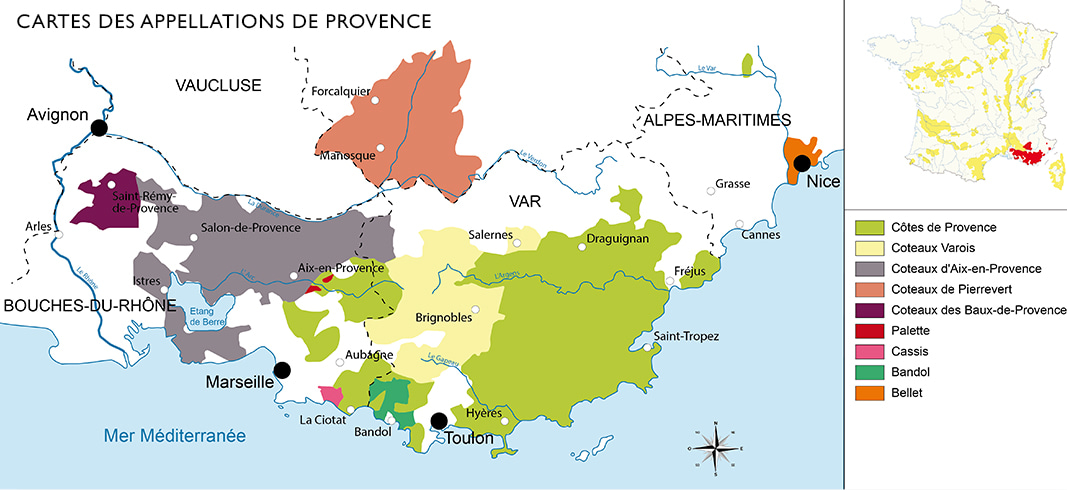
The wine appellations of Provence:
AOC Cassis in 1936 (200 hectares plantés)
AOC Bandol 1941 (1560 ha)
AOC Bellet 1941 (58 ha)
AOC Palette 1948 (40 ha)
AOC Côtes de Provence 1977 (20100 ha)
AOC Coteaux d'Aix en Provence 1985 (4120 ha)
AOC Coteaux Varois en Provence 1993 (2630 ha)
AOC Baux de Provence 1995 (280 ha)
AOC Coteaux de Pierrevert 1998 (450 ha)
The 21st Century - Provence Rosé on the Global Stage
In the 21st century, Provence rosé has established itself as a wine in its own right on the global stage. A wine of freshness, conviviality, and aromatic clarity, it aligns naturally with the consumption habits of new generations.
Through its versatility and balance, it engages effortlessly with contemporary cuisines around the world and embodies a modern vision of viticulture where tradition and international openness converge.
Massif des Maures
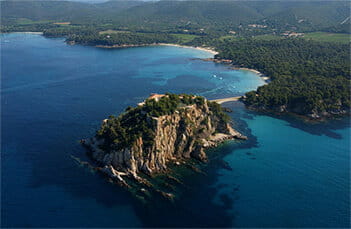
The Massif des Maures is a relic of the Hercynian chain dating from the Carboniferous period. It outcrops on the most beautiful parts of the Var coast from the islands of Embiez and Sanary to the west, to the islands of Hyères to the south and rises north-east along the Côte d'Azur to the valley of the Siagne in the immediate inland of Cannes. It is composed of weakly metamorphosed detrital sedimentary rocks, the Phyllades, in its western part. These Phyllades, flyschs, of Porquerolles for example, date from the Ordovician and the Silurian. They were deposited at the foot of the ancient northern oceanic margin of Gondwana in the Paleo-Tethys Ocean some 400 to 450 million years ago. Then, going east, the rocks are of a deeper origin within the mountain range and are composed of mica schists, gneiss then granite. These rocks give fairly clear, shaly and schisty soil in the sectors with gneiss and mica schists, to more sandy soils in the sectors with Phyllades, and arena sands in the granite sectors.
The permian extensional phase
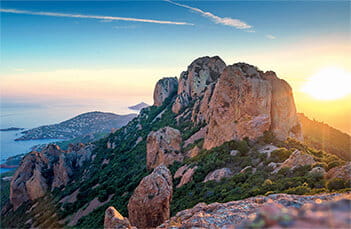
In the valley going north-east from Toulon to Le Muy, passing through Cuers, Le Luc, Vidauban, then with the Massif de l'Esterel, we find rocks of volcanic origin, red sandstones with some conglomerates, then the more or less reworked basalts and rhyolites of the Massif de l'Esterel. Everything dates from an episode of continental extension in the Permian. These rocks give dark to dark red siltstone and sandstone soils that are rather acidic and drain well. The terraces of the valley of Esclans with well drained sandstone and clay soils on slopes facing south east are among the best terroirs in the region.
The limestones of Provence
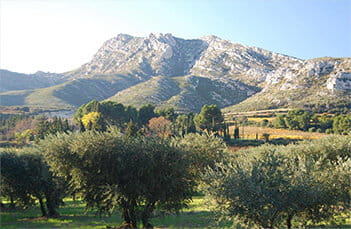
They cover the north and west parts of Provence above the great Permian valley. They start with the limestones of the Triassic, wich are more or less dolomitized, of the central Var where limestone highs of the Jurassic like the Sainte Baume and the famous Sainte Victoire stand. Further west, we find the massive limestones of the Cretaceous, the blue marls of the Gargasian (Aptien, 120 MA) in the vineyards of Cassis, the rudist limestones of the Turonian (90 MA) and the clear sandy marls of the Santonian (85 MA). ). In the Alpilles, we find the vineyards between the limestone bars of the Lower Cretaceous.
The Tertiary period
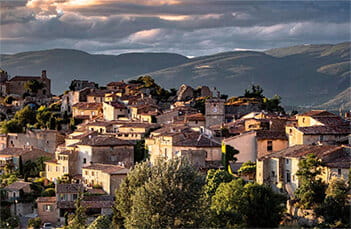
In the Luberon, the soils are of a more recent geological age, mainly from the Miocene. Above Nice, the vineyards of Bellet develop on a characteristic soil made up of a coarse conglomerate with a sandy-clay matrix, the work of reworking by the Var of the pre-Alpine reliefs upstream.
Grenache Noir
Typically Mediterranean grape from Spain, it
is the main grape variety for red wines in the Rhône Valley and the rosés in
Provence. It brings aromas of ripe red fruit,
roundness, body and supple and slightly marked tanins. Red cherry aromas, strawberry, blackcurrant, black pepper and liquorice combined with a nice roundness and
medium body give fullness on the palate, power and goloso appeal. Rosés
take advantage of these gourmet aromas and light to fine tannins.
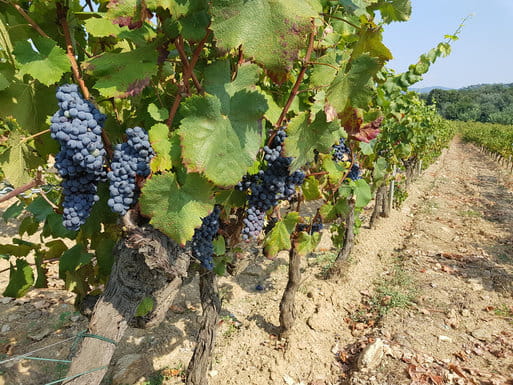
Cinsault
Originally from Provence where it still accompanies Grenache in
rosés blent with other red grape varieties like Grenache, Syrah or Mourvèdre. It is very resistant to
Drought. It brings fruit flavors to the blends with aromas of fresh red berries: gooseberry, wild strawberry; with suppleness and
finesse often in very good accordance with the amplitude and the fruit of the Grenache.
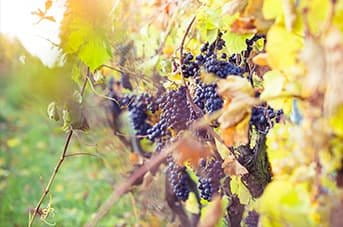
Syrah or Shiraz
Originally from the north of the Rhône Valley, it is mainly
vinified into red wine blended with Grenache, Mourvèdre and Cabernet Sauvignon. He
develops aromas of red and black fruits, raspberry, blackberry, blueberry,
flowers like violet and spices like black truffle, black pepper and
licorice. He is the main contributor in the Provence reds except in Bandol where Mourvèdre is King.
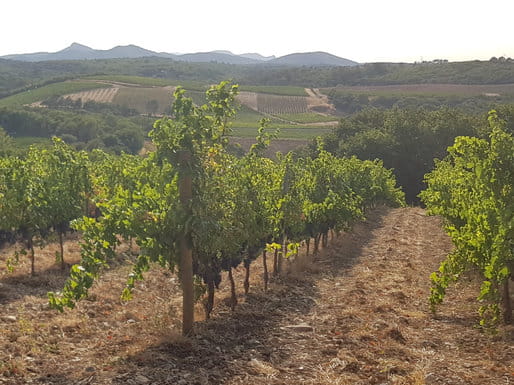
Rolle or Vermentino
A Corsican and Sardinian grape at the origine, this truly mediterranean grape is very well adapted to Provence and Liguria. It is a vigorous grape sensitive to wind and powdery mildew with late maturing. It gives light and balanced fatty wines with a
low acidity developing floral aromas (hawthorn, chamomile), fruit aromas:
grapefruit, vine peach, fresh almond, pear, red apple. In Provence
it can be combined with Ugni Blanc, Clairette, Sémillon or
enter during fermentation in the vinification of rosés, up to 20%, to
bring fatness, freshness and complexity.